
Customers abandon carts for multiple reasons. Recent industry research shows that the average online shopping cart abandonment rate is approximately 70.2%, meaning roughly 7 out of every 10 shoppers leave without completing their purchase. As a business owner, it’s your responsibility to ensure that you employ the right abandoned cart recovery strategies to ensure that they return.
As a business, when you offer discounts or coupons, you are employing one of the best strategies to recover from abandoned carts. Customers tend to add items to their shopping baskets with the desire to purchase them, but they may abandon it due to several reasons. When they abandon carts, your business is at risk of losing a sale.
So the best thing you can do is provide them with an incentive to return! This is in the form of sales or a discount, which convinces people to make a purchase.
As a result, giving discounts for abandoned carts may entice people to make a purchase.
However, such discounts and promotions have their time and place. Even spectacular success can sometimes have disastrous consequences.
But we’ll go over that in greater depth later. In this blog, we’re going to take a look at the Best Abandoned Cart Recovery Strategies for WooCommerce!
But first, let’s take a look at why shoppers stop themselves from making a purchase!
Why do shoppers abandon carts?
Before we understand how to recover abandoned carts, it’s important to know why this may occur. Shoppers tend to abandon their carts due to a multitude of reasons. But a few reasons that have been commonly expressed include;
1. Unexpected Shipping Costs
Hidden fees are one of the leading causes of abandoned carts. Customers may feel comfortable with the prices mentioned on the website, but as soon as they reach checkout, an unexpected shipping fee, taxes, or handling fees may leave them in doubt.
What you can do to avoid this:
- Show shipping costs early.
- Offer free shipping thresholds.
- Display estimated delivery charges on product pages.
2. Complicated Checkout Process
A lengthy checkout process creates friction. It makes customers hesitant to complete the shopping process.
Common issues include:
- Too many form fields
- Multiple checkout pages
- Confusing navigation
- Slow page loading
To solve this issue, you can;
- Use a one-page checkout.
- Remove unnecessary fields.
- Enable autofill and address suggestions.
3. Forced Account Creation
Many customers want a quick purchase experience.
Forcing users to create an account before checkout often increases abandonment.
To avoid this, you can enable guest checkout while offering account creation after purchase.
4. Slow Website Performance
Even a few extra seconds of loading time can reduce conversions. Mobile shoppers are particularly sensitive to delays. Customers want the shopping process to be as seamless and quick as possible.
To optimize website performance you can;
- Optimize images
- Use caching
- Choose quality hosting
5. Limited Payment Options
Shoppers expect flexibility and restricting payment choices can cause customers to leave.
So to ensure that shoppers continue buying, you can offer them payment options such as ;
- Credit cards
- Debit cards
- UPI
- Apple Pay
- Google Pay
- Buy Now, Pay Later options
What Is Cart Abandonment?
Cart abandonment occurs when a shopper adds products to their cart but leaves the website before completing the purchase.
For example:
- A customer adds a pair of shoes to their cart.
- They proceed to checkout.
- Before paying, they leave the site.
- The order remains incomplete.
This represents a missed sales opportunity.
Cart Abandonment vs. Checkout Abandonment
Cart Abandonment
- Customer leaves after adding items to the cart.
Checkout Abandonment
- Customer starts the checkout process but does not finish payment.
Understanding where customers drop off helps identify the best recovery strategy.
What is Abandoned Cart Recovery?
Abandoned cart recovery is the process of reconnecting with shoppers who leave your store without completing their purchase and encouraging them to return and finish the checkout process.
Rather than viewing abandoned carts as lost opportunities, successful ecommerce businesses treat them as potential revenue waiting to be recovered. There are several abandoned cart recovery strategies that you will explore further, which help ensure that customers return to buy from your store.
Abandoned cart recovery typically involves automated marketing and conversion optimization strategies such as:
- Abandoned cart emails
- SMS reminders
- WhatsApp recovery campaigns
- Push notifications
- Retargeting ads
- Personalized offers
- Checkout optimization
The goal is simple: remind customers about the products they were interested in and remove any obstacles preventing them from completing their purchase.
What are Abandoned Cart Emails?

When a consumer adds a product to an e-commerce site’s online shopping cart but does not proceed to checkout and finish the transaction. Users may depart because they are not yet ready to purchase. Instead, they use their basket as a “wish list” while they look around and compare costs. Setting up automated, tailored email alerts to remind consumers that they have things in their basket is frequently all that is required to get them to finish checking out.
Almost 70% of online customers leave their shopping carts before checking out. People abandon their shopping carts for a variety of reasons. But here’s the good news: using abandoned cart emails, you can entice them to continue their purchase.
If you’ve ever abandoned an online purchase, you’ve probably gotten abandoned cart emails, which frequently arrive in phases. The first is often a polite nudge to finish your transaction. The second may add a deadline, and the third generally offers a coupon or discount to entice you to return.
Understanding Coupons

Coupons are used by businesses because they are plainly effective.
A lot of extensive economic research has been done on relative prices and the impact of coupons on demand.
Coupons assist individuals in overcoming the most significant obstacle to acquiring a long-term customer in the initial purchase.
It is tough to persuade someone to make a first-time purchase. However, after you’ve done it once, persuading them to do it again should be a lot easier.
When you think about coupons as a technique to precisely target first-time purchasers, an abandoned cart coupon makes a lot of sense in that this is your last shot to convert a window shopper to a customer, and that in turn offers you the opportunity to convert them to regular customers.
Now that we have an understanding of abandoned cart emails and customers, let us take a look at the top strategies to increase conversion and sales with the help of abandoned cart coupons
Why Coupons Work for Abandoned Cart Recovery?
Coupons work because they address one of the biggest causes of cart abandonment: hesitation.
A small incentive can give shoppers the final push they need to complete their purchase. Beyond reducing the purchase price, coupons create urgency, reward customer interest, and make buyers feel they’re receiving additional value.
That said, discounts shouldn’t be your only recovery strategy. When combined with personalized reminders and an optimized checkout experience, coupons become significantly more effective.
15 Best Abandoned Cart Recovery Strategies
Emails from abandoned carts are an excellent location to give a discount. An abandoned cart discount is less likely to attract price-conscious buyers since it is placed behind an email.
And, by including a coupon in the second or third email in your abandoned cart automation, you may convert genuine buyers into regular customers without reducing your profit margins too much. The following abandoned cart recovery strategies are among the most effective methods for recovering lost sales in 2026.
Welcome New Customers with a First Purchase Discount

Assume a site visitor is unfamiliar with your e-commerce store. They may have only recently heard of your business and are unsure whether or not to make a purchase.
A first-purchase discount might encourage customers to take the risk and place their first order. This is especially crucial for wholesale customers, as they may be making a substantial purchase.
If you have a visitor who has never purchased from your company before, this type of promotion might be what converts them into a regular client. After their initial purchase, you may add them to your email list and give them more attractive bargains in the future.
Example:
“Welcome! Complete your order today and enjoy 10% off your first purchase.”
Offer Discounts Based on Social Sharing
Lower pricing or time-sensitive incentives may be enough to attract new clients. This is true for customers who were previously uninformed of a store or brand, as well as customers who have not purchased from a store or brand because the costs are deemed to be too expensive.
This may benefit your business not just by bringing in new consumers, but also serves as its own kind of marketing. Because you only provide discounts to consumers who share your store profile with their connections, you save money on marketing while attracting genuine and loyal customers.
Loyalty/Reward Points

If a shop has already sold products to a consumer, offering discounts or promotions may entice them to return.
However, a client may buy something once and never look back. To avoid this, establish a loyalty program or something similar. For example, if a consumer purchases a product or is a frequent shopper, offer them reward points that they may accumulate and use in the store at a discounted rate. These can be sent via abandoned cart emails.
This method raises your sales while also keeping your customers satisfied. Furthermore, the buyer will return to your business because the reward points are only valid there.
Exclusive Coupons and Memberships
Personalized and unique discount coupons, even one-time use codes, may create an aura of exclusivity, whether for VIP customers or utilized to retain clients. These discount codes will seem personalized for the consumer, providing them with a more pleasurable customer experience.
This strategy may be applied by giving multiple levels of membership in your shop to clients. The greater the tier, the more coupons or discounts they will receive.
This works as a supplement to the cash generated by selling your products.
Offer Coupons for Unsold Products without making it obvious
One of the most basic reasons for decreasing a product’s price is to make it more likely to be purchased. This urge exists for all products, but if a product goes unsold, discounting it may become the only option to generate enough demand to ship it. This can be caused by a variety of factors, ranging from a time-sensitive product, such as perishables, to a simple demand underestimation.
Make certain that the buyer does not receive the impression that they are being pushed outmoded or undesirable things in such a circumstance. Hype up these things in the same way you would any other product while delivering a significant discount in contrast to other products.
Free Shipping Coupons

Shipping and delivery are important aspects of e-commerce shopping since consumers buy online for convenience. Offering free delivery is an excellent strategy to retain clients since it removes a direct expense that may have been holding them back. Customers have learned to anticipate free delivery as more e-commerce stores have begun to provide it.
In a significant number of studies, free shipping coupons had the greatest open and click-through rates when compared to other techniques. Furthermore, you save money because you don’t need to give any further coupons, as this appeals to the buyer as a discount and a price decrease.
Instead of discounting your products, consider offering:
- Free standard shipping
- Free express shipping above a spending threshold (Free shipping for orders above $100 or $50)
- Limited-time free shipping codes
This preserves product value while removing one of the biggest purchasing barriers.
Buy One – Get One Coupons

A buy one, get one (BOGO) deal indicates that when buyers buy one item, they receive a second item for free or at a reduced price.
Giving your consumers free things motivates them to make a purchase. You get extra points if you market it as a limited-time deal.
These types of coupons may be used to generate BOGO discounts with single products, groups of products, or whole product categories. All of these methods can help your ecommerce store decrease cart abandonment.
Additionally, this may help you get rid of unsold products by adding those to the BOGO offer as the “Get One” prospect.
Flash Sale Discounts
Flash sales are limited-time offers that are only available for a limited period. They are successful because they capture consumers’ attention and can create excitement about bargains.
Flash sales can generate a sense of urgency in order to convert abandoned carts into sales.
In a nutshell, this type of promotion generates a sense of urgency and may prompt customers to act swiftly. This is because people may be more likely to buy if they believe they are about to lose out on a fantastic deal.
The “Black Friday Sale” or “Independence Day Sale” is a well-known example of such a technique. This is a tried-and-true approach utilized by millions of merchants across the world to increase conversions and sales.
Percentage-Based Coupons
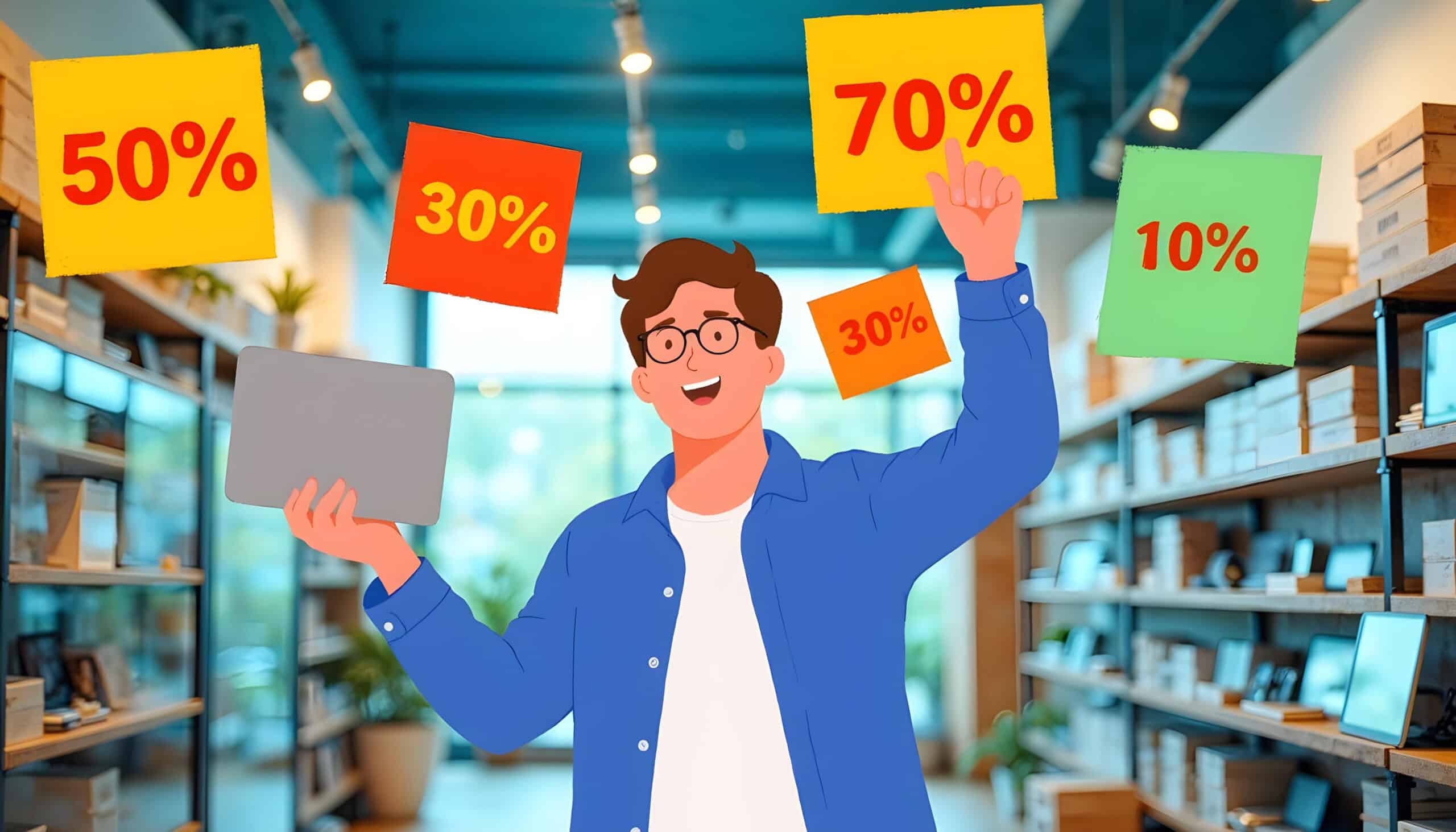
Percentage-based discounts are a typical coupon approach. This is a terrific technique to give scalable discounts, as you may offer these reductions on both high- and low-value orders. Percentages shield you against large discounts on low-value carts.
Percentage-based discounts offer high open and click-through rates, but a low revenue per recipient. While more consumers open and click on these offers in recovery emails, you recover less income per recovered sale than other discount tactics.
While it may come as a surprise, smaller percentage discounts resulted in the largest income per abandoned cart recovered. Lower percentage discounts nevertheless encourage customers to return while reducing your loss of income as a merchant.
For example:
- 10% off orders above $75
- 20% off premium collections
This encourages customers to complete larger purchases while protecting your profit margins.
Use Fixed-Amount Coupons
Fixed-amount coupons are essentially those that you offer to your customers based on their cart value. It creates an immediate and strong psychological impact because customers are able to understand how much they’ll be saving.
The average order value is a crucial consideration here since it has a major influence on how much you can recover. Dollar-based discounts yield the most income per recipient while having a lower click-through rate than percentage-based discounts and free shipping offers. In fact, these approaches generate five times the revenue of conventional discount methods. The larger the discount, the higher the open, click-through, and income per recipient.
You must pay close attention to the cash amount you give as well as the average order value of recovered carts in order to not lose out on too much revenue.
Examples include:
- $10 off orders over $50
- $20 off purchases above $100
These coupons often outperform small percentage discounts on medium-sized orders because the savings feel more tangible. Customers will feel excited to spend more to get the discount and save money.
Create Limited-Time Coupon Offers
Urgency motivates action. Having limited-time offers for a specific amount of time motivates individuals to come buy from your store. Instead of sharing a coupon that never expires, make it time-sensitive.
This is one of the best abandoned cart coupon strategies to exist which works best.
Examples include:
- Valid for 24 hours
- Expires at midnight
- Ends this weekend
Pair the coupon with a countdown message in your recovery email to encourage quicker purchasing decisions.
Offer Product or Category-Specific Coupons
Instead of discounting your entire store, target only the products left behind in the abandoned cart.
For example:
- 15% off shoes
- Buy one, get one on accessories
- 10% off selected electronics
Targeted promotions are more relevant to customers and help maintain healthier profit margins.
Leverage Seasonal and Holiday Coupons
Major shopping events create a natural sense of urgency, making them the perfect opportunity to recover abandoned carts. Customers are always looking out for a steal during Halloween, Christmas, New Year’s, or any other holiday.
During seasonal campaigns, shoppers are already looking for the best deals. A well-timed coupon reminder can encourage them to return and complete their purchase before the promotion ends.
Popular occasions include:
- Black Friday and Cyber Monday
- Christmas and New Year sales
- Valentine’s Day
- Mother’s Day and Father’s Day
- Back-to-School promotions
- Halloween
- End-of-Season clearance sales
For example, if a customer abandons their cart during a Black Friday sale, you could send an automated email reminding them that their exclusive 20% holiday discount expires in the next 24 hours. Pairing seasonal offers with countdown timers or limited-time messaging can further encourage customers to make quicker purchasing decisions.
Seasonal coupons work best when combined with personalized recovery emails and clearly communicated expiration dates, creating urgency without relying on deep discounts year-round.
Combine Coupons with Personalized Recovery Emails
A coupon alone isn’t enough. Part of running an e-commerce store is making your customers feel special. To do so, you can combine coupons with personalized recovery emails.
It makes the customer feel like the discount coupon is exclusively for them, making them eager to use it.
The most successful recovery emails include:
- The customer’s name
- Images of products
- A clear call-to-action
- A personalized coupon
- A direct “Return to Cart” button
Sending the right message at the right time significantly improves recovery rates.
A simple email sequence could look like this:
After 1 hour: Friendly reminder.
After 24 hours: Highlight product benefits and answer common concerns.
After 48 hours: Offer a limited-time coupon if the customer still hasn’t returned.
Checkout Optimization
The most effective way to recover lost sales is to prevent abandonment from happening in the first place.
Checkout optimization focuses on removing friction, simplifying the purchasing journey, and helping customers complete their orders as quickly as possible.
Multi-channel Recovery
Many e-commerce stores rely on abandoned cart emails a lot. But a lot of customers respond differently to emails, messages, and other communication methods. Modern shoppers interact with brands across several channels.
Using a multi-channel recovery strategy increases visibility and improves the chances of bringing customers back.
Why Multi-Channel Recovery Works
Different customers respond to different communication channels. Some of them respond to email, SMS, WhatsApp messages, push notifications, or re-targeting ads. So what you need to be doing is adopting a multi-channel recovery.
A multi-channel strategy ensures that you reach customers wherever they are most active.
Manually tracking abandoned carts and sending personalized coupon emails can quickly become overwhelming, especially as your store grows. The ELEX WooCommerce Abandoned Cart Recovery with Dynamic Coupons plugin automates the entire process by detecting abandoned carts, sending scheduled recovery emails, and generating dynamic coupon codes that encourage customers to complete their purchases. This allows store owners to recover lost sales with minimal manual effort and deliver timely and relevant offers at the same time.
AI Personalization
Modern e-commerce stores are increasingly using artificial intelligence (AI) to make abandoned cart recovery campaigns more relevant. AI can be utilized for several other aspects of your sales journey. But the most important part it can help with is automating content and personalizing your customers’ messaging.
AI can help you:
- Recommend complementary or recently viewed products.
- Personalize email subject lines and content.
- Send recovery emails at the time customers are most likely to engage.
- Segment customers based on shopping behavior and purchase history.
- Deliver different coupon offers based on cart value or customer loyalty.
Personalized recovery campaigns feel less like marketing messages and more like helpful reminders, often leading to higher engagement and better conversion rates.
Common Mistakes
Even well-intentioned campaigns can fail if they’re not executed strategically. There are several mistakes that you can avoid to ensure that your abandoned cart recovery strategy works.
Avoid these common mistakes:
- Offering discounts to every customer, regardless of intent.
- Sending too many recovery emails and overwhelming shoppers.
- Ignoring mobile users during checkout optimization.
- Using generic email content instead of personalization.
- Waiting too long before sending the first reminder.
- Failing to test subject lines, email timing, or coupon values.
- Not analyzing campaign performance.
A thoughtful abandoned cart recovery strategy focuses on delivering value rather than simply offering bigger discounts.
Conclusion
It’s simple to determine whether discounts are beneficial to your objectives by evaluating how your company interacts with customers.
They can be vital and useful in some situations, such as competing with competitor businesses during busy seasons when customers demand discounts. Other times, they might cause more harm than good, such as when attempting to instill exclusivity and a sense of luxury in a product or service.
In order to automate the entire process on your WooCommerce store, check out the ELEX WooCommerce Abandoned Cart Recovery with Dynamic Coupons plugin.
If you decide to provide discounts and coupons for your e-commerce business, the tactics outlined above may be useful. We hope you enjoyed this content and learned something valuable.
FAQS
- What is a good cart recovery rate for WooCommerce?
Most ecommerce stores recover between 5% and 15% of abandoned carts. Highly optimized stores can achieve significantly higher recovery rates. - Do abandoned cart emails really work?
Yes. Abandoned cart emails remain one of the highest-performing ecommerce email campaigns because they target users who have already shown purchase intent. - How many abandoned cart emails should I send?
A sequence of three emails typically provides the best balance between engagement and customer experience. - Is SMS better than email for cart recovery?
SMS generally achieves higher open rates, while email provides more space for product information and promotional content. Combining both often delivers the best results. - Can guest carts be recovered?
Yes. Many WooCommerce recovery solutions can track and recover guest carts when customer contact information is captured during checkout. - What is the biggest reason customers abandon carts?
Unexpected costs, complicated checkout processes, and trust concerns remain among the leading causes of cart abandonment.